
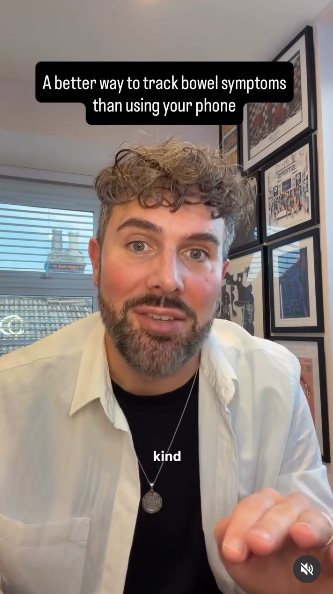
Keeping track of bowel symptoms shouldn’t be a guessing game. DJ Dallyn shares how the Food and Symptoms Journal helps turn scattered notes and forgotten details into a clearer picture of bowel health
Trying to explain your bowel symptoms to a doctor isn’t always easy, particularly when your only record is a vague recollection that Tuesday was bad. For Dan Edwards, better known as DJ Dallyn, this is a familiar experience. Diagnosed with stage 3 bowel cancer in October 2024, Dan knows first-hand how difficult it can be to piece together changes in bowel habits and symptoms when relying on memory alone.
In a recent video, Dan shares why keeping track of bowel health matters, both before and after diagnosis, and how a more structured approach has helped him.
Why keeping track of bowel symptoms matters
Before his diagnosis, Dan admits he was a particularly bad detective when it came to remembering different bowel movements and working out what had happened and when. He says: “Trying to explain your bowel symptoms to a doctor when your notes just say Tuesday bad is a special kind of hell.”
It’s a familiar problem. When symptoms fluctuate, details such as frequency, consistency and potential triggers can quickly become difficult to recall. And diagnosis doesn’t mean the need to keep track disappears. Food, symptoms, treatment side effects and changes in bowel habits can all provide useful information.
Having these details in one place can help people recognise changes and give healthcare professionals a clearer picture of what’s happening between appointments. As Dan says: “I’m talking symptoms, food, side effects, things that make your bowel habits better or worse.”
Why your phone doesn’t always have the answer
Although a phone might seem like an obvious place to record symptoms, Dan highlights how easily information becomes scattered across messages, notes and different apps.
The Food and Symptom Journal brings everyday tracking together, with dedicated space to record meals, food preparation, drinks, bowel movements, symptoms, medication and supplements, alongside sleep, exercise, mood and energy levels.
Dan wishes he had something similar before his diagnosis. Now, he uses it post-diagnosis to monitor changes and believes it could be particularly useful during treatment or when managing a long-term bowel condition.
Making bowel health conversations easier
Being able to describe changes in bowel habits can make healthcare appointments more productive. A record of frequency, stool consistency, urgency and associated symptoms gives people something concrete to refer to, rather than relying entirely on recollection.
For Dan, encouraging people to talk more openly about bowel health is also important, particularly among men.
He adds: “Fellas, we are particularly bad at keeping a track of things, so why don’t you pick yourself up one of these?”
Daniel Edwards is founder and chair of Booty Call CIC, an organisation aiming to inspire open conversations about bowel health within the LGBTQ+ community, challenge embarrassment and encourage people to recognise changes and seek medical advice.
Taking the chaos out of symptom tracking
Dan’s message is simple: keeping a record of bowel health shouldn’t feel like another complicated task. Whether you’re experiencing unexplained symptoms, managing IBS or IBD, living with a diagnosed bowel condition or monitoring changes during treatment, a structured journal can help bring important information together.
As Dan puts it: “If you want to take the absolute chaos of monitoring symptoms out of your head and onto a page, go and see The Good Bowel Company.”
The Food and Symptoms Journal is designed to make everyday tracking more manageable, helping people build a useful record to refer to and share with their healthcare professionals.
The Good Bowel Company also donates 5% of every Food and Symptoms Journal sold to Bowel Research UK, helping support research into bowel conditions.